I wrote this piece to explain why pseudonyms make sense to me. Writers have always used names, personas, and distance to protect themselves while still telling the truth. In today’s world, that feels harder. Everyone is expected to have a brand, a face, and a story attached to the work. I’m thinking through what it means to write honestly, stay private, and still let the work speak for itself.
Published: 1/7/23
Revised: 8/15/26 -
I wrote this piece to explain why pseudonyms make sense to me. Writers have always used names, personas, and distance to protect themselves while still telling the truth. In today’s world, that feels harder. Everyone is expected to have a brand, a face, and a story attached to the work. I’m thinking through what it means to write honestly, stay private, and still let the work speak for itself.
I understand why some of the most famous pseudonyms exist. I understand why those individuals didn’t use their legal names; instead, they used pen names.
I’ve wondered: how does one fullyconceal their identity today?
Back in the 1800s, there wasn’t social media.
Back then, they could supplant their name with another and write what they wanted.
They could be daring. They pushed boundaries through their work. They challenged conventional ways of thinking. They circumvented cultural norms.
They simply needed to be creative and talented.
This isn’t to say we must harken to the Victorian era as a beacon. It’s just a reference point.
It wasn’t about having a brand. It was about the commitment and dedication to the craft. This allowed them to challenge socially accepted beliefs through composition.
They understood that consumers would take it personally – especially if the work was produced with great conviction. For this reason, they used a pseudonym to conceal their identity.
… Fortunately, and unfortunately, in the modern age, everyone has a pseudonym.
A username. A profile name.
Where users- I mean, people comment anonymously.
…As I ponder how I can conceal my identity in 2023.
Everything revolves around building a brand. If you work professionally, that’s part of your brand.
Hell, if you don’t work, that’s your brand. That’s why people use usernames.
They really shouldn’t say it with their chest while they get paid biweekly.
I’m an artist too, though. And I studied aspects of my craft within the classroom. I was required to learn the history, and I enjoyed it.
This isn’t to say you can’t master a craft without guidance or tutelage. But how skilled could a basketball player be if they only practiced in the driveway? It doesn’t matter how many hours they put in. Sooner or later, they gotta play against other talented players and see where their skills align. The greatest study not just their contemporaries, but also their predecessors.
So yeah, you’re funny on your page with the audience that you cultivated. But are you funny?
Do you know what makes something or someone funny? How has funny adjusted over time? Who are the funniest people you know, or who have influenced your humor?
Is this snobbish?I suppose so.
I’m getting tired of virality, I want more originality & substance.
I’ve used pseudonyms since childhood. For as long as I can remember, I’ve never, not been creative.
I was considered “different” back then, and I’m still different today. I was never the fit-in type. Any attempt at assimilating made me unhappy. Trying to think, speak, or act like everybody else simply to fit in made me depressed. I’d rather be a “wierdo” than be accepted on the pretense.
As I matured, I realized the people around me didn’t know where I came from or how I got there.
Once I realized my path and journey were different, I began to embrace my identity in every aspect of work and life. Professionally – and creatively.
Through my career, I realized professionalism was the equalizer. If I conducted myself with decorum, treated everyone with respect, and most importantly, performed well in my position(s), then my outside interests didn’t need to align with my colleagues. I didn’t need to pretend that I shared common interests. I didn’t share palatable outside interests because I didn’t grow up similarly.
I don’t hike, I don’t camp, and I don’t golf…
I do know about the dedication & sacrifice required to navigate and engage within those social spaces. I experienced the hardships, personal losses, and grief to reap some of the benefits. Through overcoming and success, it provided an opportunity to share wisdom and knowledge with others with a similar background – specifically told through narrative.
I quit trying to be liked once I realized that most people like what they want to hear or see. And it took about 28 years to arrive at this realization. That we all control our algorithms. So, I decided to stand pat.
Creatively – I wish I could quantify in hours how much time I’ve spent developing my style. Truthfully, I lost count/track years ago.
I’m creative, intellectual, and I enjoy writing. That’s how I would describe myself. That’s how I’ve approached professional work throughout my career.
As I began reflecting on my personal journey, I shared the experience through narrative. Revealing the realness of the process. The honesty and the transparency, well – that’s when people stopped liking what they didn’t want to hear.
I had a rough life growing up, no matter how you slice it. Based on my circumstances, I wasn’t supposed to be where I was, and I wasn’t supposed to conduct myself the way I did. However, I never wanted to come across as hood or ghetto. I always wanted to lead with kindness and grace. I was always respectful until certain individuals thought it was okay to play with my name.
That’s when I needed to step out of character and let people know that just because I’m nice doesn’t mean I’m to be played with. And I did not take solace in doing that either. This is what I try to tell people: those who are really about it, or really from it, ain’t all rah-rah. They’re often quiet and calm until you upset them.
People kept upsetting me because they kept treating me like a mark. So, I started keeping it real, and they didn’t really like that.
That’s the life of a creative; you’re likely to share something that may not be palatable to others. That’s why certain authors use pseudonyms.
I went through all the trials & tribulations of being different, and I learned to accept it. My unique charm is what connects people to me.
Conversely, it can create distance. Certain individuals will be uncomfortable with my presence no matter what I say or do. And that is okay, as long as they’re okay. If you’re reserved or quiet, that can be an issue around certain people. Or, if you’re too chatty and talkative, that can be an issue too. So, as long as you are yourself, people will decide accordingly.
In the 1830s, a writer could publish something inspired by their own life. They would alter the names or locations in the story and then classify their work as fiction.
Because, what is fiction?
Fiction simply means that the events described did not occur in real life. It lets storytellers use their imagination.
Fictional stories often evoke the same emotions as real-life stories. They can make you happy, sad, mad, or confused depending on the plot. The setting doesn’t matter because every story has human elements. After all, humans create it, and humans consume it.
Fictional work is full of insinuation & innuendo. Perhaps the average consumer may not catch all the hidden messages, but those educated and trained in literary criticism will analyze the work.
My reading habits differ from those of a casual reader. I’m not just focused on what happened in the plot, but on why it happened and the message the creator is trying to convey.
One of the biggest pieces of advice that I share with storytellers is not to waste any words or lines. Everything on each page should set something up down the line. And I’m not referring to the profundity of a line. Not every sentence needs to be Shakespearean, but even simple phrases must have importance.
I’ve pondered: Can a writer use a pseudonym when writing nonfiction?
… From a scholastic & theoretical standpoint, I don’t think so. Well, I don’t know, I’m unsure, and it’s why I ponder… It would be like publishing a memoir under a fictitious name.
Patchy was my first alter ego, and I got that nickname in grade school. It represented a carefree, free-spirited persona. It was a mindset that helped me see the good in people and focus on what I could control. I’ve always been proud of who I am, and I enjoyed being around like-minded people. We just kicked and had fun. It was a genuinely good time.
Do they treat people with respect? Are they kind to others? Do they have an optimistic outlook on life? Someone's internal beliefs are not of Patchy's concern.
The second alter ego was Old School Pat, and I developed that persona in high school. It stemmed from my affinity for old-school/classic music and film that preceded my generation. It represented the foundation of the art that I would later consume. I deeply appreciated modern artists who paid tribute to those who came before them.
This later became popular and trendy on platforms like TikTok, as people realized their favorite current songs were samples of older songs. This was coupled with content creators building a brand around going to WhoSampled. ☝️
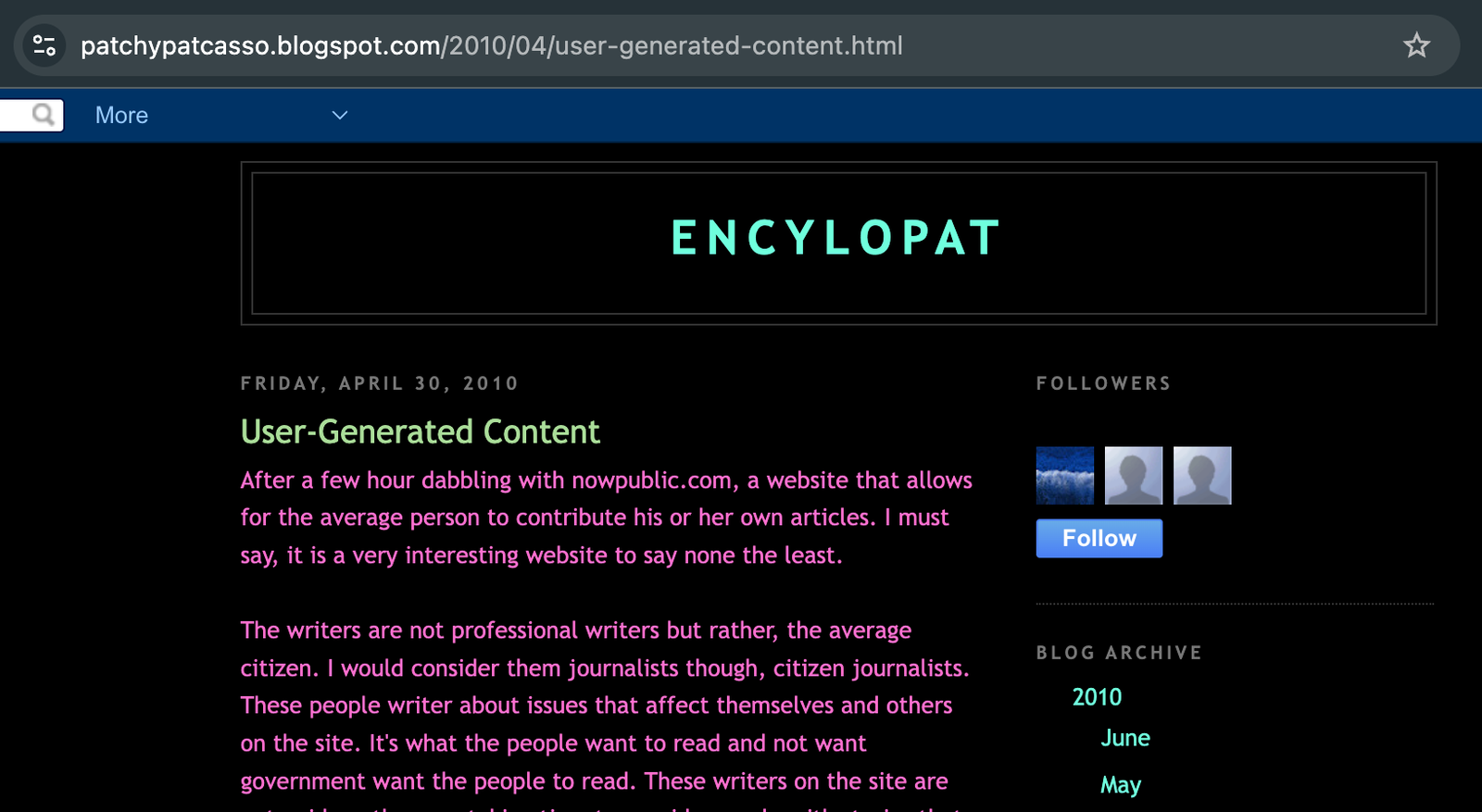
Next was EnclyoPat. This was early college. I built a foundation of intellectual curiosity toward the end of high school, in my junior and senior years, when I became aware of Black academics and intellectuals and wanted to be recognized for being intelligent and enjoying learning.
EncyloPat, obviously a reference to an encyclopedia, was the first time I published using a pseudonym. I also went by PatchyPatcasso because I wanted to paint pictures with words.
PatchyPatcasso was later shortened to PatchyP.
PatchyP did not come out of nowhere. I have not been building this plane as I fly. As I mentioned earlier, everything builds on itself.
Then we have the polarizing pseudonym I developed in my late 20s. We have StandPat.
– STANDPAT –
I was transparent about the inspiration for the pseudonym StandPat. I was communicative about the purpose and goal of using the signifier, StandPat.
To “stand pat” on anything means simply that. It means remaining firm in your decisions. Be considerate and deliberate, but stand your ground. I have always stood pat regarding my content. Even when the work makes people uncomfortable. Who cares? It’s not always about enjoyment and entertainment.
Whereas Patchy, Old School Pat, and EnycloPat were more lighthearted, StandPat represented the grit and intensity that I had been hesitant to showcase. It was quite a persona shift, and initially I wasn’t sure how the tone would land with people.
At first, it was intense. Over time, I had to calibrate the tone. I was calling out places, people, institutions; no filter, it was very raw. For example, I’m not big on using profanity, verbally or in writing. However, with my ambitions to write for the screen, people use swear words. It’s not academic or editorial writing, so I had to get comfortable writing fuck and not f**k. So, fuck this and fuck that.
I was calling out individuals and groups who were misguiding the community for their personal benefit. Understand that I was tapped in, so these were individuals I had been around or had worked with in a professional capacity. Coupled with my tone, people projected that I was experiencing a mental crisis, and some tried to put that jacket on me, but I wouldn’t wear it… Years later, I stand affirmed in everything that I shared, but I understood the gravitas of going against the grain.
Even with the signifier of StandPat, the message was associated with me as a person.
This isn’t the 1840s, or even the 1900s. It’s the 2000s; we’re in a digital age. My real name is Patrick. So, could I fully expect people who knew Pat, the person, to distinguish the literary tone in the content as a StandPat? Although –
I was transparent about the inspiration for the pseudonym StandPat. I was communicative about the purpose and goal of using the signifier, StandPat.
No, I didn’t.
I expected people to jump ship, especially those I didn’t know well- acquaintances. I mean, what did I write earlier in this piece?
That’s the life of a creative; you’re likely to share something that may not be palatable to others.
I also don’t want to mistake it for copium. It’s not justification to be intentionally disrespectful and distasteful just to keep it real or for artistic freedom. I’ve been studying intellectual discourse since I was a teenager; amazing academics and historic civil rights organizers mentored me. More importantly – I did the work. I wasn’t simply a talking head.
That’s what threw me for a loop with certain individuals who dissociated. Looking back, it was for the best. Those who understood my intentions are the ones I remain connected with, because I’ve learned that in today’s society, almost worse than being guilty is being accused. Countless public examples show notable figures who have been accused of something or labeled as something, and everyone uses groupthink and piles on. Then the accusations end up being false; all of a sudden, they’re liked again, as if they weren’t hated on.
In the Introduction I of FreeSense, I wrote the following:
However – I possess an instinctive aptitude in identifying beauty amongst the unseen. The competence to recognize greatness in the present. All the while, affirming those individuals who are often misconstrued and misunderstood.
FreeSense: An Anthology of Sh*t I WROTE.
My entire professional career, and most of my life, has been in service to others. I could’ve had a much more lucrative career had I been as selfish as others; it wasn’t like I didn’t have the right connections.
Ultimately, I realized that if I stood pat, I’d be judged harshly. That I was going to get mislabeled. A pseudonym couldn’t save me. But in the long run, I would be affirmed. That’s why I documented and published it. It’s why I called it FreeSense.
We’re in “clips-not-context” culture. The average attention span has decreased precipitously. Anything over 100 words requires a summary guide. Fewer people watch full videos over 10 minutes or read entire articles over three paragraphs.
Yet, these people are still commenting and gossiping, formulating opinions and perspectives based on partial or inaccurate information. Too many virtual lawyers and digital detectives.
To hell with enrolling in an actual journalism course, right?
If you have an online following, then you can be just that. An online journalist, a blogger.
Conversely, do journalists even leave the newsroom anymore?
I don’t even know. It’s been years since I worked in a newsroom.
I ADMIT – I write long pieces. So, to keep readers engaged for extended periods, my delivery and content must be on point. It can’t feel like people are reading 4000-words or 15+ pages.
I’m sorry, but true essays are long. Anyone can sound profound in 140 characters. Just writing one contradiction after another. That ain’t a byproduct of standing pat. That’s about going viral, anything for likes and follows.
I take pride in my education and all the literature and media classes I took. I write with purpose, not to impress through my diction.
Imagine reading hundreds & thousands of words of a text you cannot fully understand. It’s one mistake I see with junior writers. Trying to sound like a writer, instead of just being one. There’s a lyric to a song that I love.
🎧 What good do your words do if they can’t understand you? 🎙
Prioritize the message and the plot, and don’t overuse multisyllabic words. When public speakers use too many large words that people don’t understand, they’re often perceived as untrustworthy & dishonest. Unless they can do it well or the audience is their target demographic.
My discourse is direct yet conscious. It should affect people in their soul. I’m a soul writer. I channel my pain, trauma, and hardship to empower. I don’t let personal hardship hold me back from my goals. Life happens, and it’s always a part of the story, no doubt. But after a while, it’s like, get it done.
I despise using the term “trained writer” because it creates almost an elitist mindset, just because I have a degree in it. No, you don’t need to have an English degree to be a good writer, but you do need to have read, or like to read, classic (or quality) literature. Putting words on a page doesn’t make you a good writer. You should at least know what literary devices are.
I’ve been storytelling for a long time. When I write, it’s not for clout; it’s not for views. I’ve had to build and sustain a career; create space for reflection and introspection; and become comfortable taking literary risks and the ramifications that come with them.
I think the greatest writers spend their early years developing their writing tone and literary style. As they mature, as they get older, and gain wisdom, that’s when perspective arrives. That’s when you take literary risks because you have experience to fall back on. Young writers care about their work being respected or liked. They think about marketing and promotion before the plot. They’re trying to feed an audience instead of building one. They value the algorithm over the work.
I can’t knock it because that’s the landscape they’ve created. Publishing houses and production studios want submissions that can guarantee a mass audience. But my favorite shows are the ones that didn’t initially have widespread success, but later became critically acclaimed. It’s the art that people didn’t understand at first, but later realized how deep it was.
That’s how I approach my creative process.
Yet everyone who consumes can feel my work. They can resonate with parts of it or the whole message. My work isn’t a “brand,” I’m not selling anything. But rather, I’m giving it away for a cost.
But hell, I’ve also been giving game away for free for a long time. FreeSense.
That is what real is. It’s wisdom.
If this were the 1800s, the Victorian era, there wouldn’t be a need to know StandPat’s identity. As long as the narrative was up to par.
… But I don’t know, but I feel as though pseudonyms and fictionalized work have a similar intent. To create distance.
For creatives, composers of literature – not to be confused with technical writers, grant writers, journalists, bloggers, etc… The similarity is that we put words on a page, but we don’t share the same intentions. However, many journalists are now creative writers.
But importantly, as a creative, your work should never “fall in line,” because there is no AP style for creative writing. However, prose is absolutely a skill. It’s a talent. It is not innate. And just because a person enjoys it doesn’t mean they’re good at it.
Unfortunately, in the modern age, skills don’t matter much if there’s no market for it.
In the 1820s, a writer could release a novel or essays sharing harsh critiques of society. They could publish that work under a pseudonym while still maintaining a normal life. Without fear of judgment, reproach, or other ramifications.
If the work was good, then it would get published and advertised. Not because a publisher agreed or aligned with the content. Nah.
However, a writer’s work required originality. No “buzzwords” or trendy topics or common themes. No clichés. Back then, authors couldn’t shortchange the creative process by generating an online following. They needed to build a genuine following because readers still cared about the author. Now, many people ghostwrite for others because the landscape is different, and everyone is just trying to get paid. And I can’t knock that; I’m open to co-writing – but my name will always be attached to my work.
However, writers must hone their craft. Over several years.
Baldwin wasn’t always Baldwin. Morrison wasn’t always Morrison. Their work developed over time. Still, their earliest writings hinted at the legacy to follow. But you could see the talent was always there.
Good writers tell a story. Everyone else introduces their baggage to the story.
I feel people often do things simply to garner a reaction. This has become the goal of social media because it’s lucrative and offers financial incentives.
Many people are fine with accepting social currency in exchange.
Meanwhile, I sit still, struggling to understand why people care so much about knowing who I am. Not even necessarily who I am, but rather what I look like, what personal items I own, or where I’ve ventured. Which is all fine and dandy, I suppose.
I question the ultimate purpose or intent of sharing this type of personal detail. To market success to others?
Fictional work creates anonymity for writers because readers will always ask: did that really happen?Was that a real-life situation?
I believe that if the plot feels too real, then chances are it is. The author uses their imagination to write around the situation. They fictionalize the experience.
A pseudonym is intended to create that anonymity for writers. Whether they compose fiction or nonfiction.
My conundrum is that we categorize everyone and then place all similar people in the same pot.
“If it sounds like, if it looks like, then it must be.”
This leaves little to no nuance or critical thought.
… And I don’t know, but perhaps my “artistic cynicism” won’t let me acknowledge an individual as talented or qualified at their craft simply because of a mass following. It can certainly add validation, no doubt. Many people with large followings are talented at their craft. Please don’t conflate my message. It’s not a one-size-fits-everyone thing; it only applies if it does.
There’s always nuance. Some levels of success prevent certain artists from drawing outside the lines. Mostly because of contractual obligations or social expectations.
How rebellious can you be with millions of followers? You’ve got brand deals and sponsorships to be mindful of. They’ve got business partners who will no longer work with them because of one poor statement or action. Those public figures know what never to say out loud.
But we’ve all got jobs too. Many of us have careers & professional reputations. We might not be famous, but we’ve gotta watch our mouths and what we share digitally. Not just online, in real life as well.
Everybody is controlled to an extent. And I’m sorry to state this unequivocally, but it’s the truth. Whether it’s your truth or not.
To sacrifice anything for self-liberation? HaHaHa – most are unwilling… So, they compromise instead. They even go against their beliefs. Sometimes – they don’t even know any better. They’ll jettison their values, morals, and integrity for an opportunity to get “the bag.”
Tell me that YOU’RE real … That YOU keep-it-real.
Then be yourself on social media. Your true self. And see if all your people remain.
For most, it’s not worth being alone. For some, it’s not worth sacrificing relationships.
I write from my experience. I’m not afraid to share it. I no longer keep secrets; certain people just hear it first. I cannot be guilted without shame.
If it’s a lie, I will call it out. And if it’s true, I will admit to it. I’m content with who I’ve become. It has taken hella work. It’s not conjured, it’s not my imagination, and it really happened. Or, it really happens….
I’m not afraid to be in public because much of my career has been public-facing and community-oriented. I’m not a keyboard warrior. However, I do enjoy the mystique. People wondering what I’m up to, how I’m doing, or where I’m at….
Or perhaps they’re not. We all think we’re main characters in this thing called life. People who have never done anything for their community or for others, believing they’re the topic of conversation, are the arrogance that social media has provided.
Ain’t nobody here to see you Otis…
Well, that’s music to my ears. Out of sight, out of mind, is the ideal. That’s why you don’t see my government listed throughout this website.
Some of the greatest didn’t go by their real name.
I can understand & relate to why they used a pseudonym.