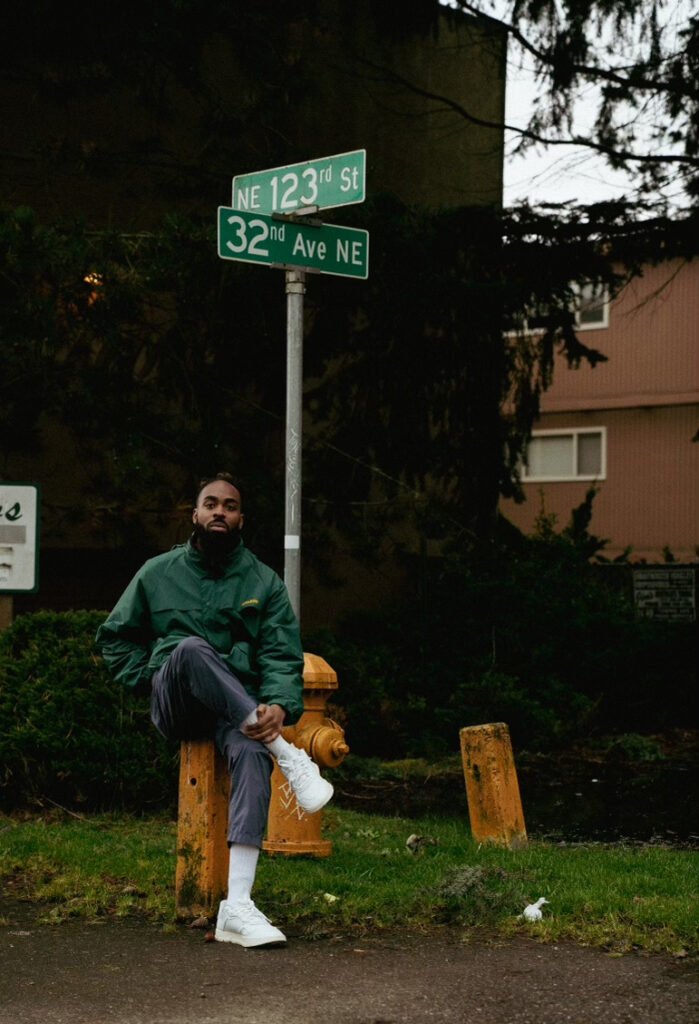
Who is PATCHYp?
PATCHYp became more than a childhood nickname. It came to represent the part of myself that could move between different worlds without completely belonging to any of them. The neighborhood, the classroom, the dugout, the professional world, and eventually the creative space. At the core, Patchy is about community and connectedness. Kicking it with all people without losing sight of where I come from. StandPAT is also part of me, but PATCHYp is the version that I'm trying to to lead with.
Baseball was how I got the nickname Patchy. Like hella kids growing up in the 90s, especially in Seattle, I wanted to be just like Junior. When I got my Nintendo 64, one of the first video games I bought was Major League Baseball featuring Ken Griffey Jr. Then I got Ken Griffey’s Slugfest when it was released. I wore those games out, literally all day and night.
At nine years old, I put the controller down and joined a baseball team. In the fourth grade, I played for the Yankees, and the following season I played for the Cardinals. I can’t lie, I had hella fun in the dugout. I played multiple positions, and I wasn’t that good at any of them. While I wasn’t great at baseball, I got mine here and there. I spent a lot of time in the outfield, especially in center field. I wanted to be like The Kid, but most of the kids couldn’t hit the ball that far.
I told coach, “Put me in the infield; I’m bored out here…”
I remember during a practice, one of our coaches called me from the outfield to come practice at catcher. I had told the head coach that I was a utility player because, in my mind… I could play all the positions. So the coach said, “Alright, put on the catcher’s gear and help me with batting practice.” As I was putting on the gear, another one of our assistant coaches yelled to me,
“Okay!! I see you! Let’s go, Patchy Baby!!”
I had no clue what a “patchy” was. I thought it was a Beach Boys song or something. I actually never thought to ask the coach what it meant, so to this day, I don’t know the origin of the name. Still, that coach would always yell “Patchy Baby” when I showed up for practice or a game. At first, I didn’t think much of it because I thought it was just a team nickname. However, some of my teammates were also my classmates. One day at school, they started calling me Patchy Baby. After that, other students started calling me Patchy Baby.
I became PATCHY at ten years old.
In Seattle, middle school begins in sixth grade at 11 years old. I remember that while I was completing the application for my next school, there was an open field to add a nickname. So, I wrote in “Patchy” and didn’t think much about it.
Not until the first week of school, when the new teachers did roll call. One of the teachers asked the class:
“WHO IS PATCHY??”
I raised my hand,
“It’s me, I’m Patchy.”
Patchy was the name. That’s how everyone came to know me.
I grew up in Lake City on 123rd and 32nd, and went to schools northeast of the city. I remember the first weeks of middle school, when other kids were hesitant to hang out with me because of the company I kept. These were kids who lived down the block from me, or in the neighborhood. The issue was my homies kept getting in fights and beating up the kids at the new school. Our new classmates lived in upper-middle-class and affluent communities. Wedgewood, Ravenna, Bryant, Laurelhurst.
These were the communities my friends and I would ride the bus to trick-or-treat at on Halloween because they had full-sized candy bars. And they’d actually open the door when we knocked. Sometimes, they’d leave an entire bowl on the porch.
Our new middle school classmates were kids from a nice community, but a few would try to poke and prod at my homies on some “na na boo boo” type-shit. Mind you, these na-na-boo-boos would schedule their fights. They’d even walk past the opposition several times during the school day on some “meet me at Dahl Field at 3:15. I’ll see you after school.”
… And at 3:15, you’d see a large group of students walking down the hill to the playfield, and everyone’s like, “So-and-so’s about to fight.”
With my homies, it was always on sight. They weren’t about to go back and forth to negotiate a squabble; talkin’ bout, “I’ll see you later…” Nah, they’d just wail on them during passing period. I seen it! They’d drop their backpack and start firing… Fist-to-face.
My homies would drive us to school when they were in the eighth grade, and I was in the sixth. Obviously, middle school didn’t have a student parking lot, so we parked in the staff lot.
For most elementary schools, students attend with peers who live nearby, typically within a few miles of the school.
Even the kids who didn’t grow up on my block in Lake City didn’t live too far away. We at least went to the same grocery stores and other public spaces.
In middle school, the geographical boundary expanded. It fed from multiple elementary schools. I attended Seattle’s largest middle school. So it was a cultural adjustment, even though it was in the same region of the city. But I had never gone to school with kids whose parents were rich, if not wealthy.
Overall, I was pretty chill, but I had my Lake City moments, too. I’d like to believe that I was the voice of reason in most of those situations. Although the middle school did put me in anger management class… It helped.
The homies from my hood, we all played street baseball, or “alleyway baseball.” Parking lot baseball or gravel baseball.
However, with my baseball teammates, we played on manicured grass, or turf. After practice, the team parents would bring full-sized snacks and drinks. I’d go over to their houses after practice. My teammates had their own room or wing of the house. It was chill vibes and quality living. They started calling me Patchy.
With the homies from Lake City, we just stayed in some shit.
Fuck it, I’m going by Patchy… Call me Patchy. I don’t need these white kids to be scared of me.
Let’s kick it.
After a few weeks in middle school, I realized how solid a lot of the students were. Yeah, there was always gonna be the few d-heads that talked tough until they got punked in the mouth. But the majority of the kids at the school were hella cool.
I also realized at 11 and 12 years old that it was their first time attending school with kids who grew up like me or my friends. These new kids put me onto their lexicon and their interests.
Because I wasn’t with the rah-rah, it wasn’t long before everybody started gravitating to me. I brought swag and originality to the school. Interestingly, the way I present myself today isn’t much different from how I was as a kid.
I functioned with everyone. And I didn’t forget about the homies from my block either, but I didn’t cross-pollinate social groups because I didn’t need the homies looking for licks.
I always believed in connecting with people, and not dividing & conquering. I didn’t want the other kids to fear me; I just wanted them to be respectful. That said, don’t let me absolve myself of accountability, because I was equally culpable as my homies who were fighting those kids. I wasn’t an innocent bystander in some of the instances.
“I’m going-going, to Cali-Cali…”
I moved to Northern California in eighth grade, and Patchy did not travel with me. To my new classmates, I just went by Patrick or Pat. Also, I was no longer the popular kid that everyone knew; I was a regular student. In fact, I was an outsider because I was not even from California. Seattle wasn’t even on the map back then. No one talked about Seattle unless you liked sports or Nirvana.
Moving to California was a tougher adjustment because I was coming from a different state. I felt so out of place moving right before starting high school that I never fully adjusted. Additionally, my family moved several times in the five years that I lived there. Constantly switching schools and making new friends was rough.
Living there from 13 to 18 drastically altered my mindset. After I graduated high school, I moved back to Seattle.
Grand Opening/Grand Closing… back to Seattle.
When I moved back to Seattle, one of the first orders of business was to reconnect with everyone who knew me as Patchy. However, the transition wasn’t seamless. Five important years had passed, and I was no longer the same Pat people knew before I moved. The city was also in rapid transformation and was not the same environment that I fondly recall as a child,
It sparked self-reflection about who I was in a changing Seattle. People expected me to be the same person when I came back. But I hadn’t been Patchy in so long that all I remembered were memories. Seattle didn’t just change; California changed me.
Ultimately, I told myself that I didn’t want to be that person who kept reminiscing about high school, or middle school in my case. I needed to start building a future, especially if I wanted to remain in Seattle long term.
Since moving back to Seattle, I’ve forged a solid path. Some of that work is showcased on this website. But also understand, it’s a small fraction of the full picture. There’s so much more that is not showcased on this platform
My other persona, StandPAT, represents the side of me that had classmates cautious, if not scared, to be associated with me. That's 123rd and 32nd, Pat. That's the alter ego that I prefer to suppress. As much as I've grown and matured today, there are moments when it's an internal battle to suppress the inclination to revert to that old version of myself.
I wonder, do your beginnings ever fully escape you? Like, if you grew up in the hood, does the mindset ever fully leave?
PATCHYp reflects community and connectedness. Kicking it with everybody.
I feel like in current society, everything is divisive. Everything feels promotional and inauthentic. Somebody is trying to sell you a course, a product, or a lifestyle. People are even selling mindsets.
I’ve never acquiesced to trends; however, I do survey and analyze the social landscape to better understand the current discourse.
PATCHYp's work is reflective of being on the baseball field or in the dugout with all your friends eating sunflower seeds. Going for ice cream after practice. Bringing a cooler full of Gatorade for everyone after an intense workout.
StandPAT is always within me.
But that isn’t how I’m trying to lead off…
Baseball.